MICHIGAN SSM-319-II-0 Rh Blade Steel Propeller Spline
fits year: 2013–2019.
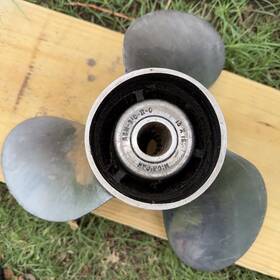
( Brand: Michigan ), ( Manufacturer Part Number: SSM-319-II-0 ), ( Part Type: Blade Propeller ), ( Hub: 15 Spline ), ( Propeller Rotation: Standard ), ( Country Of Origin: United States ), ( Material: Stainless Steel )
Review MICHIGAN Rh Blade Stainless Steel Propeller Spline Very Good Cond fits 2013–2019
The **Michigan SSM-319-II-0 13" x 19" RH Blade Steel Propeller with 15-Spline Shaft** is a high-performance, precision-engineered marine propeller designed for boats ranging from mid-sized cruisers to performance-oriented vessels, offering an optimal balance of efficiency, durability, and thrust. Crafted from high-grade **maraging steel**, this propeller is built to withstand the rigors of saltwater corrosion, frequent use, and demanding operating conditions, ensuring long-term reliability even in the harshest marine environments. The **13-inch diameter** and **19-inch pitch** combination provides a versatile power-to-thrust ratio, making it ideal for engines producing between **100 to 250 horsepower**, depending on boat speed and load requirements. The **right-hand (RH) rotation** ensures proper alignment with most standard outboard and stern-drive setups, maximizing propeller efficiency and reducing cavitation.
This propeller features a **three-blade design** with carefully optimized **hydrodynamic contours**, allowing for smoother water flow and reduced noise while maintaining strong acceleration and top-end speed. The **15-spline shaft** connection ensures a secure, vibration-dampening fit, minimizing wear on both the propeller and the engine s output shaft. The **steel construction** not only enhances durability but also allows for a **sharper, more aggressive blade angle**, which improves thrust at lower RPMs while maintaining efficiency at higher speeds. Whether used in a **cruising yacht, fishing boat, or performance stern-drive application**, this propeller delivers consistent performance, fuel efficiency, and longevity, making it a premium choice for boat owners seeking both power and precision.
For optimal results, this propeller is best paired with a **high-quality marine grease** on the spline connection to prevent corrosion and ensure smooth operation. Its **universal compatibility** with most 15-spline outboard and inboard stern-drive systems including brands like Mercury, Yamaha, and Suzuki makes it a versatile upgrade for those looking to enhance their boat s handling and fuel economy without extensive modifications. Built to meet **rigorous marine industry standards**, the SSM-319-II-0 is a testament to Michigan Propeller s commitment to innovation and performance, offering boat owners a reliable, high-efficiency propeller that stands the test of time.
### **Pros and Cons of buying a Michigan SSM-319-II-0 (13" x 19" RH Blade, Steel Propeller, 15 Spline)**
#### **Pros:**1. **Durability and Longevity** Made from high-quality steel, this propeller is designed to withstand heavy use, making it ideal for boats that operate in rough conditions or are frequently driven at high speeds. Steel propellers generally last longer than aluminum ones, especially in saltwater environments where corrosion resistance is critical.
2. **Efficiency for Performance Boats** The 13" x 19" pitch is well-suited for mid-sized performance boats, offering a balance between acceleration and cruising efficiency. This makes it a versatile choice for fishing boats, cruisers, or personal watercraft that require both speed and maneuverability.
3. **Right-Hand Rotation (RH) Design** The RH blade orientation is optimized for standard outboard and stern drive setups, ensuring better thrust and efficiency when paired with the correct engine configuration. This reduces the risk of improper installation, which can lead to vibration or reduced performance.
4. **15 Spline Shaft Compatibility** The 15-spline shaft connection is a common standard for many outboards and stern drives, making this propeller easy to install on a wide range of boats without requiring custom modifications. This compatibility broadens its appeal to boat owners who may not want to invest in a specialized propeller.
5. **Cost-Effective for Heavy Use** While steel propellers are generally more expensive upfront than aluminum, their durability often translates to lower long-term costs. Fewer replacements and repairs over time can make them a financially sound choice for boats used frequently or in demanding conditions.
6. **Better Thrust in Deep V and Planing Hulls** The design of this propeller is effective for deep V-hulls and planing boats, where thrust and acceleration are prioritized. It helps the boat plane out more quickly and maintain speed, which is beneficial for towing, fishing, or recreational use.
7. **Resistance to Corrosion (Compared to Aluminum)** In saltwater environments, steel propellers are less prone to pitting and corrosion than aluminum, though they may still require occasional maintenance to prevent rust. This makes them a more reliable option for coastal or saltwater applications.
---
#### **Cons:**1. **Higher Initial Cost** Steel propellers are significantly more expensive than aluminum ones. For boat owners on a tight budget, this can be a major drawback, especially if the propeller is not immediately necessary for performance improvements.
2. **Heavier Weight** The steel construction adds weight to the propeller, which can slightly reduce fuel efficiency and maneuverability, particularly in smaller boats. This may not be a significant issue for larger vessels but could be noticeable in lightweight or high-performance applications.
3. **Potential for Cavitation Damage** While steel is durable, it is not immune to cavitation damage, which can occur in high-speed or deep-draft conditions. Over time, this can lead to pitting or erosion, reducing the propeller s efficiency and requiring maintenance or replacement.
4. **Limited Customization** Unlike some aluminum propellers, which can be bent or adjusted for fine-tuning performance, steel propellers are typically cast and fixed in shape. This lack of adjustability may limit optimization for specific boat setups or performance goals.
5. **Maintenance Requirements** Steel propellers, especially in saltwater, require regular cleaning and inspection to prevent rust and corrosion. Neglecting maintenance can lead to reduced performance or premature failure, adding to the overall ownership cost.
6. **Potential for Noise and Vibration** If the propeller is not properly matched to the boat s engine and load, it may produce more noise and vibration than an optimized aluminum propeller. This can affect passenger comfort and may require additional tuning to mitigate.
7. **Not Ideal for Lightweight or Small Boats** For very small or lightweight boats, the added weight of a steel propeller could negatively impact handling, acceleration, or fuel efficiency. In such cases, a lighter aluminum propeller might be a better fit.
---
### **Conclusion:**The **Michigan SSM-319-II-0 (13" x 19" RH, Steel, 15 Spline)** is a robust and efficient propeller well-suited for boats that demand durability, thrust, and performance in varied conditions. Its steel construction ensures longevity, particularly in saltwater or heavy-use environments, and its compatibility with common 15-spline shafts makes it a practical choice for many boat owners. However, the higher upfront cost, added weight, and maintenance requirements may not justify its purchase for smaller boats, lightweight applications, or budget-conscious buyers.
For **fishing boats, cruisers, or performance boats** operating in demanding conditions, this propeller offers excellent value. For **smaller boats, high-performance racing applications, or those prioritizing fuel efficiency**, an aluminum propeller might be a more balanced option.
### **Recommendation:** - **Buy this propeller if:**- You own a mid-sized to large boat (e.g., deep V-hull, cruiser, or fishing boat) that requires durability and thrust.
- You frequently operate in saltwater or rough conditions where corrosion resistance is critical.
- You are willing to invest in a long-term solution that reduces the need for frequent replacements.
- Your boat uses a 15-spline shaft, and you want a propeller that balances speed, acceleration, and efficiency.
- **Consider alternatives if:**- You have a small or lightweight boat where weight is a concern.
- Your budget is limited, and you prioritize cost efficiency over long-term durability.
- You need a propeller with adjustable pitch or fine-tuning capabilities (e.g., for racing or high-performance applications).
- Your boat operates primarily in freshwater with minimal corrosion risks (an aluminum propeller may suffice).
Ultimately, the best choice depends on your boat s specific needs, operating conditions, and long-term goals. If performance, durability, and compatibility are your priorities, this Michigan propeller is a strong contender. Otherwise, weigh the trade-offs carefully against your budget and usage patterns.
Details:
part #: ssm319ii0 prices
- $174.00-$225.99
specifications propboapar:
- for years: 2013-2019
- brand: Michigan
- mpn: Ssm-319-ii-0
- part type: Blade Propeller
- hub: 15 Spline
- propeller rotation: Standard
- country of origin: United States
- material: Stainless Steel
returns propboapar:
- policy: Returns Accepted
- time: 30 Days
- paid by: Buyer
seller propboapar:
- # reviews: 2683
- city: Norman, Oklahoma
- rating: 99.7%
general propboapar:
- condition: Used
- Parts Accessories > Boat Parts > Propellers
shipping propboapar:
- transit: 4-8 Days
- class: Standard
- type: Fixed
- cost: $16.95
- service: Standard
offer propboapar:
- availability: In Stock
- quantity: 1
- sold: 0
- started: April 24, 2026
- best offers: True
- options: Ship-to-home
payments propboapar:
- other
- wallet: Apple-pay
- credit card: Discover
Michigan SSM-319-II-0 Is Similar To:
- 174983 Michigan Wheel Johnson Evinrude Propeller Splines (40.5% similar) It will do the job well. 9HP and 15HP is in very good condition. This Johnson eventide propeller it does have some scratches in the paint from ordinary use...(February 11th, 2019)
- 011010 Pj-205-c Michigan Wheel Match Alum Blade Prop Evinrude Johnson (38.8% similar) Part: PJ-205-C prices...(May 24th, 2018)
- 011016 Michigan Wheel Pitch Omc Johnson Evinrude Blade Rh Aluminum Boat (28.4% similar) 13 pitch MC Johnson eventide 3-BLADE aluminum right hand this prop will fit outboards from 135 to 250. Props plus ltd. And all MC 800 stern drives...(May 9th, 2018)
- 011025 Michigan Wheel Match Aluminum Propeller For Evinrude Johnson (40.5% similar) Size - 14 x 19 part number oem shaft 13 tooth spline rotation right hand material aluminum of blades 3 condition new in box application cant find what you're looking for. The actual part may vary in appearance...(March 16th, 2018)
- 011027 Michigan Wheel Johnson Evinrude Pitch Prop Propeller Replaces Omc Bpr (34.7% similar) Clean, quality, inspected parts...(July 18th, 2018)
- 011102 Michigan Wheel Mi New Old Stock Boat Propeller Black (33.3% similar) Mi wheel new old stock x boat propeller black the item is brand and a little dusty form being in storage...(September 1st, 2018)
- 011103 Michigan Wheel Propeller Blade (40.6% similar) 5 litre 120 hp v newer 8 litre v newer eventide Johnson outboards 40 hp e-etc 45 2 Cl commercial 50. Pleasure hp 3 Cl. Litre hp sea drive 4/1 4'' gear case MC. Pleasure, hp e-etc newer 60 4-STROKE 65 3 Cl. 3 litre hp pleasure Cl. Commercial newer 55 hp e-etc 60 3 Cl. Commercial hp 4-STROKE newer 75 ...(July 20th, 2018)
- 011104 Michigan Wheel Evinrude Johnson Propeller Cobra Mi Prop (34% similar) 5l 120 hp 1980 . 5l 120 hp and NEWER1 NEWER50 2 Cl. Thru 3l 128 hp. Pleasure hp e-etc and NEWER45 2 Cl. Commercial quality aluminum alloy for strength and durability. 1986 and NEWER60 hp e-etc. Commercial and NEWER50 hp e-etc newer our part number oem, x 19 rh 3 blade al match propeller thru hub ...(April 3rd, 2018)
- 011105 Michigan Wheel Match Aluminum Boat Propeller 014984017619 (32.3% similar) ...(July 11th, 2018)
- 012005 Michigan Wheel Match Rh Aluminum Propeller 14984000178 (38.2% similar) Local pick-up OK. Questions about this item...(February 4th, 2019)
- 012015 Michigan Wheel Propeller Match (37.5% similar) High gloss black powder coat finish minimizes speed loss from drag and protects aluminum part 012015OEM, 763589NON-THRU hub exhaust 13 tooth spline rubber system applications:eventide JOHNSON14HP - 1989 25HP 8425HP commercial 9128HP this is a new propeller in the factory box...(September 10th, 2017)
